Updated June 17, 2026
What Kind of Photo Goes on a Japanese Resume?

Ujjwal Mishra
Founder, JapaneseResume.com
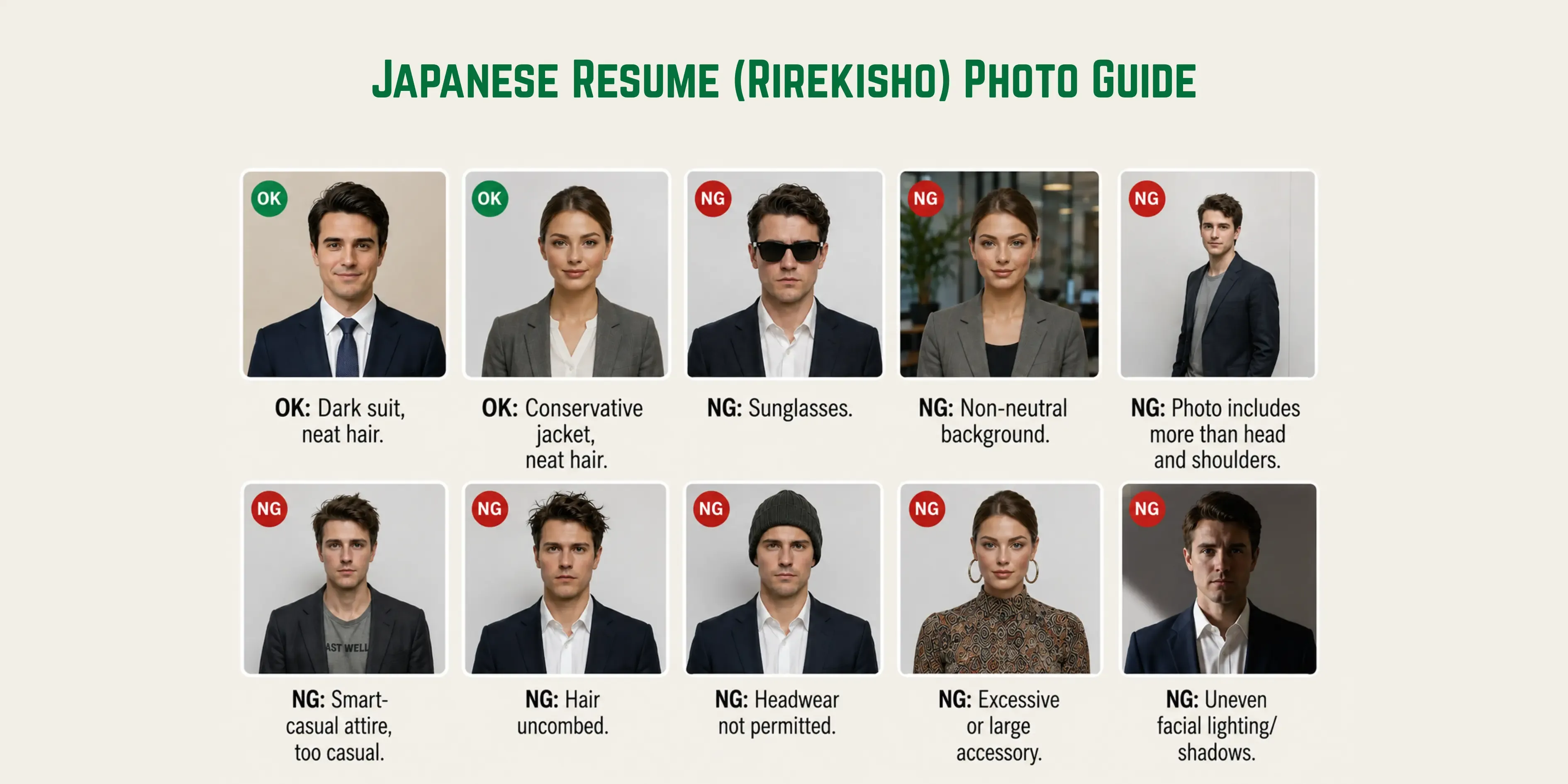
Navigating the Japanese job market can feel like entering a whole new world, especially when it comes to the rirekisho (the traditional Japanese resume). Unlike in many Western countries where adding a photo is discouraged to prevent bias, in Japan, it is an absolute necessity.
But what kind of photo goes on a japanese resume? Employers use this photo to gauge your professionalism, approachability, and respect for Japanese business customs. A sloppy or casual photo can get your application rejected before a recruiter even reads about your experience. The ideal photo presents you in a formal business suit with a warm, professional, and trustworthy demeanor.
What Are the Official Japanese Resume Photo Requirements?
The physical and digital rules for a rirekisho photo requirements standard are highly strict. If you deviate from these metrics, it signals a lack of attention to detail to a Japanese hiring manager.
Metric | Requirement |
Dimensions | Exactly 3cm wide by 4cm high (30mm x 40mm) |
Recency | Taken within the last 3 months |
Framing | Head and shoulders centered, looking directly into the camera |
Background | Solid, plain color (White, light blue, or light gray only) |
Pro Tip: If you are submitting a physical paper resume, always write your full name and date of birth on the back of the photo before gluing it down. If the photo accidentally peels off in a pile of applications, HR will know exactly whose it is!
What Should I Wear? (Dress Code: OK vs. NG)
When fulfilling Japanese resume photo requirements, your attire should scream "business formal." Treat the photo session exactly like you would a final-round corporate job interview.
OK (Do's):
- The Suit / Jacket: A dark, conservative business suit or corporate jacket in black, navy blue, or dark charcoal gray.
- The Shirt: A crisp, perfectly ironed, plain white dress shirt or collared blouse.
- The Tie (for men): A neat, subtle tie in a conservative color or pattern. It must be knotted tightly to the top button.
NG (Don'ts):
- Smart-Casual Attire (Too Casual): Do not wear t-shirts under your blazer, hoodies, polo shirts, or casual outerwear. Even if it looks "smart," it is too informal for a rirekisho.
- Loud Patterns: Avoid busy, distracting patterns, bright neon colors, or overly stylized prints.
How Should I Style My Hair, Makeup, and Accessories? (Grooming: OK vs. NG)
Your expression and grooming should project a harmonious, clean vibe. The Japanese workplace highly values neatness (seiketsukan), which starts with your visual presentation.
OK (Do's):
- Neat Hair: Hair should be styled cleanly and kept out of the face. Your eyes, eyebrows, and ears should be clearly visible.
- Clear Vision: If you wear regular reading glasses daily, ensure the lenses are completely clear with no glare.
- A Pleasant Expression: Maintain a neutral yet approachable look by slightly turning up the corners of your mouth without showing teeth.
NG (Don'ts):
- Hair Uncombed: Avoid messy, disheveled, or "just out of bed" hairstyles.
- Headwear Not Permitted: Absolutely no beanies, baseball caps, hats, or headwear of any kind (unless worn for religious or medical reasons).
- Sunglasses: Never wear sunglasses or tinted lenses that obscure your eyes.
- Excessive or Large Accessories: Remove large hoop earrings, chunky necklaces, facial piercings, or distracting jewelry. Keep accessories minimal and subtle, or omit them entirely.
- Showing Teeth or Stern Glares: Do not show your teeth when smiling, and avoid looking intensely angry, intimidating, or completely expressionless.
What Are the Crucial Technical and Background Rules?
Even with the perfect outfit, technical mistakes can ruin an otherwise excellent photo. Ensure your image file or print avoids these common layout pitfalls:
- Improper Framing: The photo must focus strictly on your head and shoulders. Avoid shots that include too much of your mid-body or torso.
- Non-Neutral Background: The background must be completely flat and solid. Avoid busy office environments, outdoor scenery, or textured walls.
- Uneven Facial Lighting and Shadows: The lighting must be perfectly balanced. Heavy shadows on one side of your face or dim, low-contrast lighting look unprofessional.
- Absolutely No Selfies: Smartphone selfies distort your shoulder posture and camera angles, making them incredibly easy for recruiters to spot. Keep the aspect ratio at 3:4.
Where Can I Get My Photo Taken, and How Do I Put the Rest of the Resume Together?
If you are already in Japan, the easiest option is to use one of the ubiquitous automated photo booths (kioku-shashin) found near almost every train station or convenience store. They feature a specific "Rirekisho" mode that outputs the exact 3x4cm print size.
Yes, they also give you a digital copy! Most modern Japanese photo booths (like Ki-Re-i or Photo ME) offer a download option. Once your photo is taken, the machine prints out a sheet with a unique QR code. Simply scan it with your phone, and you can download a high-quality JPEG version directly to your camera roll—perfect for online job portals. If you are applying from overseas, a professional passport photo studio can easily shoot and cut a photo to these exact dimensions for you.
However, once you have your perfect digital or physical photo ready, you face an even bigger hurdle: actually building the rirekisho itself.
Structuring your employment history, ensuring your personal details align with rigid grid boxes, and avoiding layout mistakes can be incredibly confusing for global job seekers.
That is where JapaneseResume.com comes into play.
JapaneseResume.com simplifies the entire resume-building process. The platform allows you to seamlessly build a clean, standardized Japanese resume entirely by yourself using their intuitive online system. It handles the layout and formatting so you don't have to wrestle with templates.
Best of all, you don't have to go it alone. Once you have built your resume through the system, you can choose to have it verified by a real expert through JapaneseResume.com. An experienced professional will review your document, catch any subtle errors, and ensure it meets strict corporate expectations before you send it out.
Save yourself the stress, create your resume with confidence, and get it expert-verified at JapaneseResume.com today!
Ujjwal Mishra
Founder, JapaneseResume.com
Ujjwal is the creator of JapaneseResume.com and Founder of Nihon Code. A Tokyo Institute of Technology alumnus and former COO of Tokyo Techies, he has spent nearly a decade scaling tech operations and hiring global talent in Tokyo. Having sat on both sides of the table, navigating his own early job hunt as an expat and later reviewing hundreds of applications as an executive, he provides insider, battle-tested advice on what Japanese hiring managers actually look for.