Updated July 8, 2026
How Do You Pass Japan ATS Resume Screening and Automated AI Interviews?

Ujjwal Mishra
Founder, JapaneseResume.com
⏱️ Quick TLDR
Japanese corporate hiring teams are heavily relying on automated screening tools to weed out the massive volume of job applications. If you want to know how to pass AI resume screening in Japan, you need to stop using generic templates, build contextual word clusters in your Shokumu Keirekisho, and use measurable metrics. To learn how to pass AI interview in Japanese, remember to structure your video answers with a strict conclusion-first framework so the software can easily map your logic.
Why is a Computer Rejecting Your Application Before a Recruiter Even Sees It?
If you are applying to major Japanese corporations or popular global firms in Tokyo right now, a human recruiter probably isn't reading your initial application.
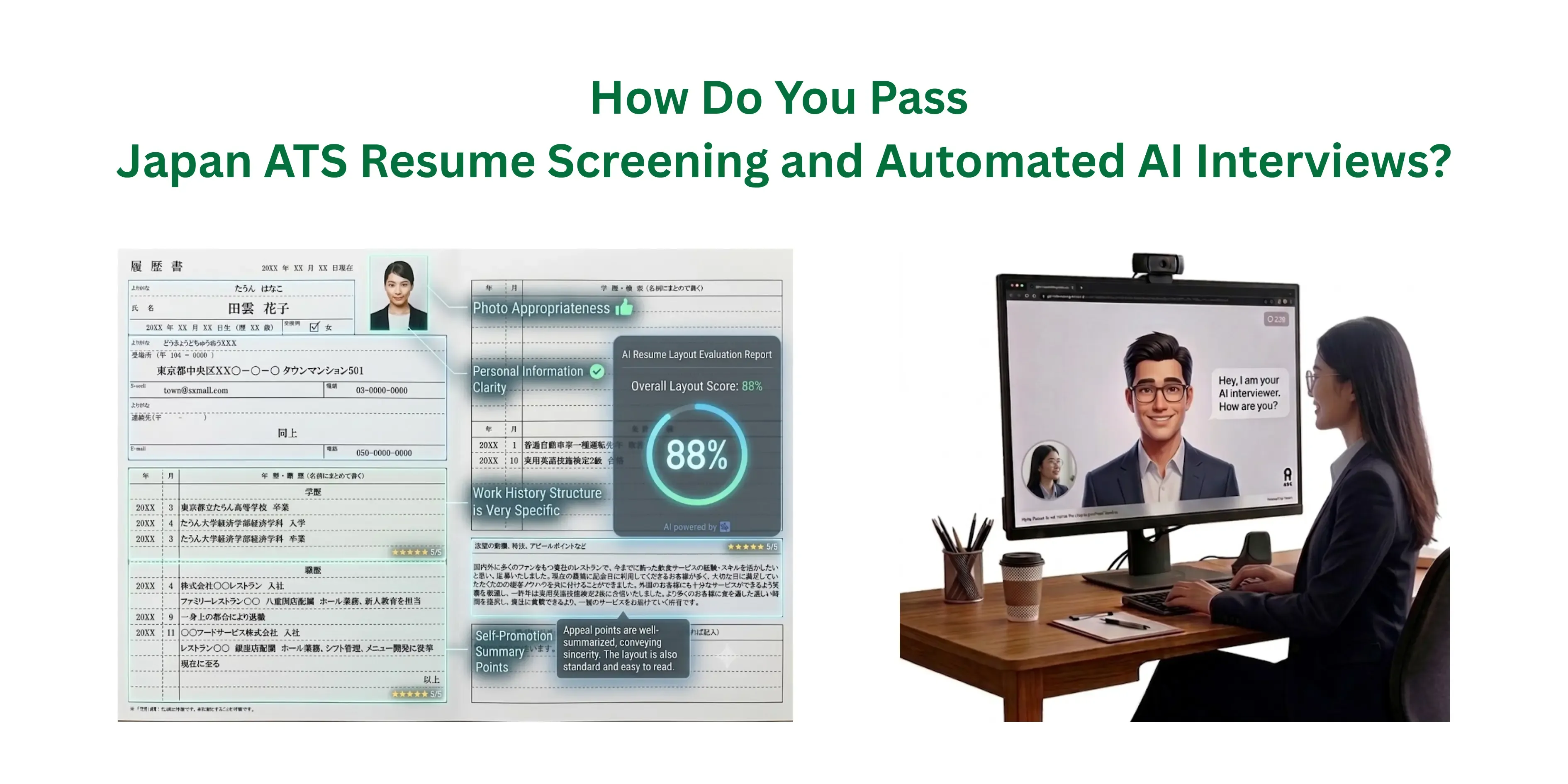
With corporate HR teams completely overwhelmed by a flood of identical resumes, companies have fundamentally shifted their strategy. Data from a corporate recruitment study published on PR Times shows that 47.9% of companies in Japan have officially integrated AI into their hiring workflows, heavily relying on it for screening and document filtering. They are turning to applicant tracking systems (ATS) and evaluation tools like PRaiO, harutaka, and PeopleX to act as the first line of defense.
This isn't just about old-school keyword scanning anymore. The screening software used by Japanese HR departments is smart enough to read your entire application contextually. It looks for logic, job alignment, and structural substance. If your application reads exactly like a basic job description or an over-polished template, the system flags it as low value and auto-rejects it within minutes.
To get your foot through the door, you have to optimize your approach specifically for these digital gatekeepers.
How to Pass AI Resume Screening in Japan and Fix Your Shokumu Keirekisho
The single biggest mistake job seekers make is thinking they can beat an automated system by simply stuffing their resume with a few random keywords. The software is smarter than that.
If you want to know how to pass AI resume screening in Japan, you need to make three practical structural shifts to your Shokumu Keirekisho (職務経歴書):
- Build "Contextual Clusters" Around Your Skills: If a job description asks for "Digital Marketing," simply repeating that exact phrase won't help you. The screening tool checks for the vocabulary that naturally lives around that skill. It wants to see terms like budget management, KPI tracking, campaign optimization, conversion rates, and vendor negotiation in the exact same paragraph. It reads the whole story, not just the single buzzword.
- Focus Heavily on Quantifiable Outcomes: Vague descriptions of your daily duties (Gyomu Naiyo) score incredibly poorly. Instead of writing, "Responsible for managing the local sales team and improving performance," make it concrete: "Managed a team of 5 account executives and increased regional revenue by 18% over a six-month period." Data is easy for screening software to parse, verify, and score highly.
- Keep Your Document Formatting Incredibly Simple: You might think a creative layout with multi-column tables, text boxes, and unique fonts looks professional, but it frequently breaks parsing tools. If the system cannot easily extract your text into its structured fields, it defaults your score to zero. Stick to a clean, single-column, standard layout using standard Word or PDF formats.
How to Pass AI Interview in Japanese Without Freezing Up On Camera
An increasing number of top-tier companies in Japan are skipping the traditional first-round human screening call entirely. Instead, they send you an automated link to a platform like harutaka, where you record your video answers to prompts displayed on your screen.
A common myth is that the software is actively tracking whether your eyes blinked too much, measuring your smile, or judging your background. It isn't. Modern enterprise tools are strictly audited to avoid those exact biases. Instead, the algorithm is listening to your structural clarity and language usage.
The biggest trap for candidates figuring out how to pass AI interview in Japanese is the cultural tendency to use long, winding sentences that end vaguely with phrases like "〜だと思いますが..." (I think that, but...). Automated language tools struggle with circular logic.
To achieve a top score, use the strict conclusion-first (Ketsuron-first) framework:
- State your main point or conclusion immediately.
- Outline the specific situation or challenge you faced.
- Explain the exact action you took to solve it.
- Share the final measurable result.
Keep your vocal pace steady—aiming for roughly 300 Japanese characters per minute—and end your sentences decisively with clear markers like "〜です" or "〜ました". This gives the software a clean, highly logical data stream to grade.
What is Your Ultimate Checklist to Pass Japan ATS Resume Screening?
Before you hit the submit button on your next application, take five minutes to run your application materials through this definitive diagnostic checklist:
- Natural Phrasing Check: Does your resume read like a real person wrote it? If it sounds like a rigid textbook or a generic corporate brochure, rewrite it with your real, personal achievements.
- Direct Job Description Mirroring: Look closely at the exact terminology the company uses in their job posting. If they specifically phrase a requirement as "cross-functional collaboration," that exact concept must feature prominently in your profile.
- The Numbers Rule: Look at every single previous job role listed on your resume. If a paragraph doesn't contain a percentage, a currency amount, a team size, or a clear time frame, find a way to add one.
- Clean Video Terminations: When practicing for an automated video round, practice stopping yourself completely after you make your point. Do not let your answers wander off into conversational filler or nervous trailing sentences.
Ready to Beat the Algorithm? Here Are Your Two Options
The automated screening tool isn't trying to pick the absolute best candidate for the job; it is simply designed to efficiently eliminate the wrong ones. It is a filter meant to clear away the noise of low-effort applications. By focusing heavily on clear data, structured logic, and rich context, you give the system exactly what it needs to pass you through to the next stage.
Now that you understand the rules of the system, you have two clear ways to handle your next job hunt:
Option 1: The Do-It-Yourself Route
You can absolutely spend this weekend pulling apart your old Shokumu Keirekisho, manually checking it against the job descriptions, and rebuilding your career history line by line using the strategies outlined above. It takes serious time, focus, and a bit of trial and error, but you now have the blueprint to do it yourself.
Option 2: Let the Experts Handle It
If you want to completely skip the guesswork and ensure your application is built exactly to pass Japan ATS resume screening, let JapaneseResume.com take care of the heavy lifting.
We built the platform specifically to solve this problem. It automatically structures your professional background into beautiful, clean, ATS-compliant formats while ensuring your experience is packed with the exact semantic data, rich context, and outcome metrics that modern Japanese HR software looks for.
Whether you choose to craft your application completely by hand or let JapaneseResume.com handle it for you, don't let an automated filter stand between you and your career progression. Get past the machine so you can sit down and talk to the human hiring manager who makes the final call.
Ujjwal Mishra
Founder, JapaneseResume.com
Ujjwal is the creator of JapaneseResume.com and Founder of Nihon Code. A Tokyo Institute of Technology alumnus and former COO of Tokyo Techies, he has spent nearly a decade scaling tech operations and hiring global talent in Tokyo. Having sat on both sides of the table, navigating his own early job hunt as an expat and later reviewing hundreds of applications as an executive, he provides insider, battle-tested advice on what Japanese hiring managers actually look for.