Updated October 2, 2026
The Ultimate Guide to Your Take-Home Salary in Japan: Gross vs Net Pay Explained (2026 Edition)

Ujjwal Mishra
Founder, JapaneseResume.com
You finally landed a job offer in Japan, and the contract says you’ll be making ¥400,000 a month (a 4.8 million yen annual salary). You mentally start budgeting for a spacious apartment in Tokyo, weekend trips to Kyoto, and endless sushi dinners.
Then, payday arrives. You check your bank account, expecting a clean ¥400,000. Instead, you see a deposit for around ¥315,000.
Why is my Japanese payslip so low? Where did the rest of your money go?
Welcome to the difference between Gakumen (額面 - your gross salary) and Tedori (手取り - your actual take-home pay or net salary). If you are moving to Japan or evaluating a job offer, using a Japan take home salary calculator or simply understanding how much tax is deducted from your paycheck in Japan is survival skill #1.
Here is a plain-English breakdown of Japan salary after tax, how to read your Japanese payslip deductions, and how tax-saving strategies like iDeCo and claiming dependents can leave more money in your pocket.
💸 The "Big Four" Deductions: How Much Tax is Deducted From Your Paycheck?
Before your salary hits your bank account (a figure listed as Sashihiki Shikyugaku / 差引支給額 on your pay stub), your employer automatically subtracts taxes and insurance from the Kojo-ran (控除欄 - deduction column). This is split into four main categories:
1. Health Insurance & Pension (Social Insurance / Shakai Hoken) This is the biggest chunk, eating up roughly 14.5% to 15% of your gross pay. Does your company pay part of your health insurance in Japan? Yes! The Shakai Hoken deduction percentage is split 50/50 between you and your employer.
- Health Insurance covers 70% of your medical bills.
- Pension goes toward your retirement (and yes, if you leave Japan, you can apply for a lump-sum refund!).
2. Employment Insurance (Koyo Hoken) This is a very small deduction (around 0.5% of your salary). If you ever lose your job, this pays you a living allowance while you look for a new one.
3. Income Tax (Shotokuzei) This is the national tax paid to the Japanese government. The Japan income tax rate (2026) is progressive, ranging from 5% to 45%. ✨ 2026 Update! Thanks to recent rule changes, you don't pay national income tax on your first ¥1.78 million of salary. This means a slightly larger net salary in Japan for many workers!
4. Resident Tax (Juminzei) This is the local tax paid to your city or ward. It is a flat 10% of your taxable income, plus a flat per-capita fee of about ¥5,000. Understanding the Shotokuzei vs Juminzei difference is key to understanding your long-term tax burden.
⚠️ The "Second-Year Surprise" (Why Did My Salary Decrease Second Year in Japan?)
If it is your very first year living in Japan, you might look at your payslip and think, "Wow, taxes here aren't that bad!"
It's a trap.
In Japan, National Income Tax is deducted from your current month's salary, but Resident Tax is billed based on your income from the PREVIOUS calendar year.
- Is resident tax zero in year 1 in Japan? Yes! Because you lived abroad last year, your previous year's Japanese income was ¥0. Therefore, your Resident Tax is ¥0.
- When does resident tax start showing up on your salary slip? Starting in June of your second year, the city hall looks at what you earned in Year 1 and starts deducting that 10% from your monthly paycheck.
This is known as the "Second-Year Surprise." Your gross salary stays the same, but your take-home pay suddenly drops by roughly ¥15,000 to ¥25,000 a month!
🛡️ Tax Optimization: How to Lower Resident Tax in Japan
You can't avoid taxes entirely, but you can legally reduce your "Taxable Income." The lower your taxable income, the less tax you pay.
1. How Does the Dependent Deduction Work in Japan? If you support a spouse who doesn't work, children, or elderly parents, you can claim them as dependents (Fuyo). For each standard dependent, Japan chops ¥380,000 off your taxable income for national tax (and ¥330,000 for local tax). Can I claim my parents abroad as dependents for Japanese tax? Yes, claiming overseas dependents is possible, but you must provide strict proof of relationship and bank transfer records proving you send them money regularly.
2. Max Out an iDeCo Account (iDeCo Tax Savings Japan) iDeCo (Individual Defined Contribution Pension) is a government-sponsored retirement account. The money you put into iDeCo is 100% tax-deductible. The iDeCo contribution limit for a company employee is usually ¥23,000 a month (¥276,000 a year). By doing this, that ¥276,000 is completely hidden from the tax man. If you use an iDeCo tax savings calculator, you'll see this saves you tens of thousands of yen in taxes every year!
3. Furusato Nozei (Hometown Tax) A must-read Furusato nozei guide for foreigners: While it doesn't increase your monthly take-home pay, it is the best life-hack in Japan. You "donate" a portion of your upcoming Resident Tax to a rural municipality. In return, they send you incredible gifts (Wagyu beef, fresh seafood, fruits, electronics). You essentially redirect tax money you have to pay anyway into getting free household goods!
🧮 Let’s Look at the Math: 400k JPY Salary Take Home Pay
To show you gross vs net salary in Japan, let's look at four different people, all making ¥400,000 a month (¥4.8 million yen salary after tax estimates) in 2026.
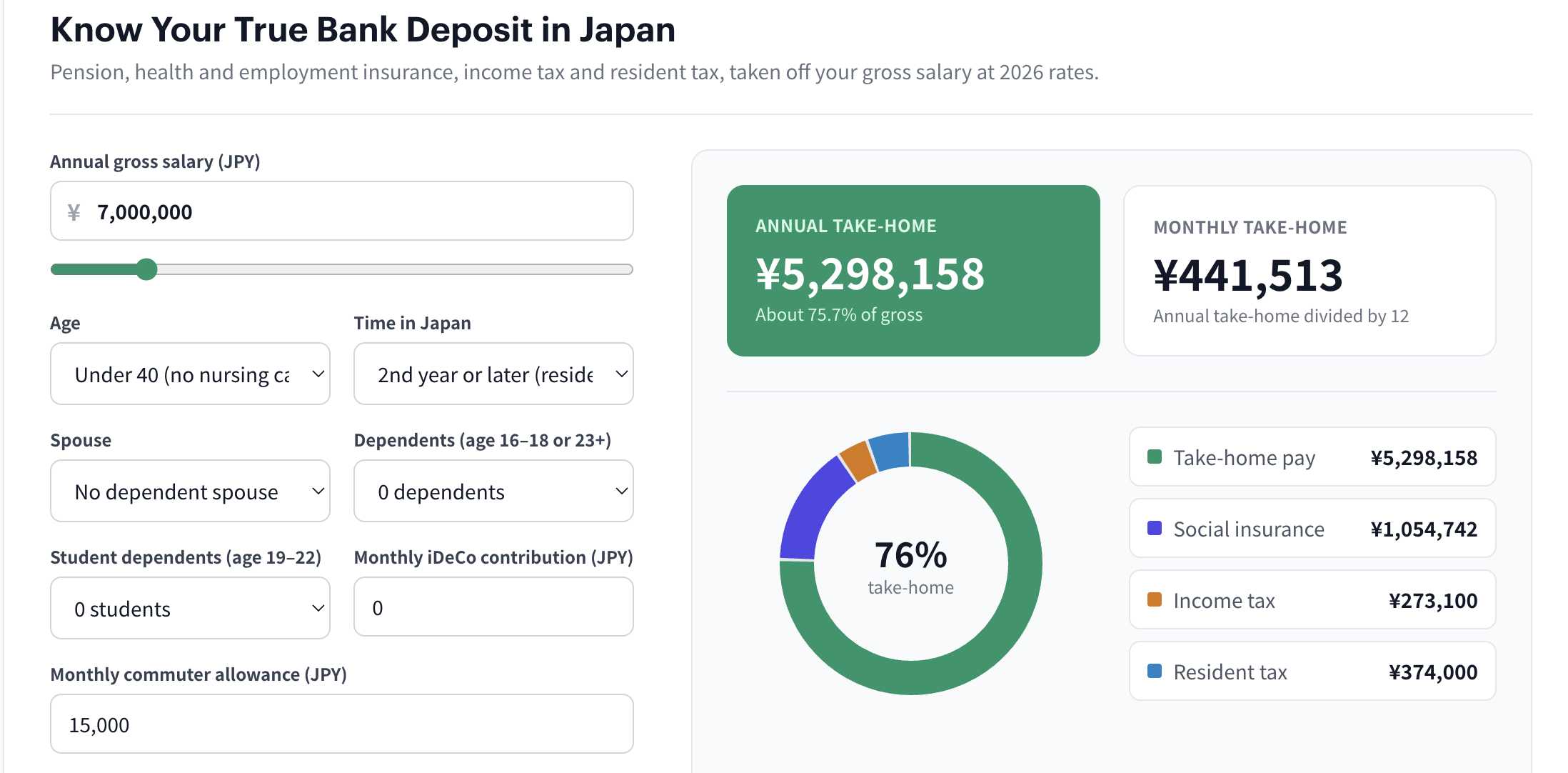
(Note: These are estimates based on Tokyo's 2026 rates. Want to calculate your exact pay stub? Test out your own numbers using our interactive Japan Take-Home Pay & Tax Calculator).
👤 Scenario A: The Fresh Arrival (Single, 1st Year in Japan)
- Social Insurance: ~¥58,520 / mo
- Income Tax: ~¥7,040 / mo
- Resident Tax: ¥0 (Because it's their first year!)
- Monthly Take-Home Pay: ~¥334,400
👤 Scenario B: The Second-Year Reality (Single, 2nd+ Year in Japan)
- Social Insurance: ~¥58,520 / mo
- Income Tax: ~¥7,040 / mo
- Resident Tax: ~¥19,300 / mo (Surprise!)
- Monthly Take-Home Pay: ~¥315,100
👨👩👧 Scenario C: The Family Provider (2nd+ Year, 2 Dependents)
- Social Insurance: ~¥58,520 / mo
- Income Tax: ~¥3,800 / mo (Dependents significantly cut the national income tax!)
- Resident Tax: ~¥13,800 / mo
- Monthly Take-Home Pay: ~¥323,800 (Notice they take home almost ¥8,700 more per month than the single person in Scenario B!)
📈 Scenario D: The Savvy Saver (Single, 2nd+ Year, ¥23k/mo into iDeCo)
- Social Insurance: ~¥58,520 / mo
- Income Tax: ~¥5,870 / mo
- Resident Tax: ~¥17,000 / mo
- iDeCo Contribution: -¥23,000 / mo
- Monthly Liquid Cash Take-Home Pay: ~¥295,600
- Wait, isn't that lower? The immediate cash landing in their checking account is lower because they set aside ¥23,000 for retirement. However, by using iDeCo, their total annual tax bill drops by roughly ¥41,600—giving them an instant, guaranteed tax return on their investments.
Landing That Dream Salary in Japan
When evaluating any job offer in Japan, multiplying the gross monthly salary by 0.8 (80%) gives you a quick, reliable estimate of your actual net take-home pay.
Of course, the best way to offset Japan's tax system is simply to land a higher gross salary in the first place. Whether you're aiming for a ¥400,000/month role or executive pay, catching the eye of Japanese recruiters and hiring managers requires a resume formatted specifically for the local market.
At JapaneseResume.com, we make it seamless to craft professional, ATS optimized, localized Japanese resumes (Rirekisho and Shokumu Keirekisho) tailored to Japanese corporate and multinational hiring standards. Create your job-ready resume in minutes, land more interviews, and secure the compensation package you deserve.
Ujjwal Mishra
Founder, JapaneseResume.com
Ujjwal is the creator of JapaneseResume.com and Founder of Nihon Code. A Tokyo Institute of Technology alumnus and former COO of Tokyo Techies, he has spent nearly a decade scaling tech operations and hiring global talent in Tokyo. Having sat on both sides of the table, navigating his own early job hunt as an expat and later reviewing hundreds of applications as an executive, he provides insider, battle-tested advice on what Japanese hiring managers actually look for.